
Tesla Model S: Wiper Motor Assembly (Remove and Replace)
Tesla Model S (2012-2026) Service Manual / Electrical / Wiper Motor Assembly (Remove and Replace)
Removal
- Ensure that the wipers are in the off position by rotating the end of the left-hand steering column lever toward you.
- Open the hood to the service position.
- Remove the cowl screen panel (refer to procedure).
- Remove the LH strut (RH strut for RHD) (refer to procedure).
- Remove the bolts (x3) that secure the wiper motor assembly to
the bulkhead (torque 6 Nm).
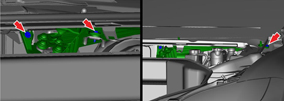
- Carefully release the wiper motor assembly and turn it to access the harness connector.
- Disconnect the harness connector from the wiper motor assembly.
- Remove the wiper motor assembly. Caution: Do not damage the harness that is connected to the wiper motor assembly.
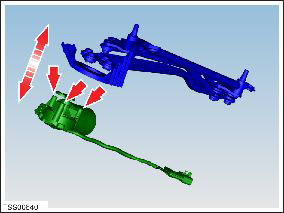
- If needed, remove the screws (x3) that secure the wiper motor to the mounting bracket (torque 10 Nm).
- Remove the wiper motor.
Installation procedure is the reverse of removal, except for the following:
- Clean the affected areas before installation.
- Ensure that the wipers are set back to the Auto position by rotating the end of the left-hand steering column lever away from you.
READ NEXT:
 Pump - Windshield Washer Reservoir (Remove and Replace)
Removal
Remove the front LH upper wheel arch liner (refer to procedure).
Position a container to collect any spillage.
Disconnect the washer pump connector.
Release the washer
Reservoir - Windshield Washer (Remove and Replace)
Removal
Remove the rear center underhood apron (refer to procedure).
Remove the plastic rivet that secures the reservoir neck to the
suspension shock tower.
Nozzle - Windshield Washer Jet (Remove and Replace)
Removal
Remove the hood acoustic panel (refer to procedure).
Disconnect the washer jet pipe from the T-piece.
Release t
SEE MORE:
Bracket - License Plate - Front (Retrofit)
Special tool required for this procedure:
Supplier
Part Number
Description
Tesla
223-28550-TSL
WIHA (TORQUE SCREWDRIVER .1 -
.6NM)
Procedure
Ankle Catcher Assembly (Remove and Replace)
Removal
Remove the front fascia (refer to procedure).
Remove the bolts (x2) that secure the center of the ankle
catcher to the front ducting (torque 4 Nm).
Remove the bolts (x4) that secure the ankle catcher to the
© 2019-2026 Copyright www.tesms.org
