
Tesla Model S: Charging the Battery
- Select Manual Mode from the Charge/Discharge Mode menu.
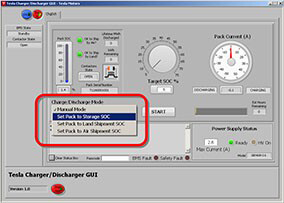
- Type the desired SOC in the Target SOC% field, or drag the Target SOC% knob to the desired SOC.
- Turn on the HV power supply.
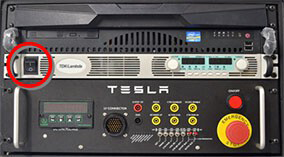
- Release the emergency stop button by turning the knob counter-clockwise.
- When the green Ready light appears in the lower right corner of the software application, select the Start button. The Start button changes to a Stop button.
- The battery contactors close and charging begins. The pack
current, charging indicator, estimated hours remaining, HV Power
Supply Ready light, HV On light, and Max Current display on the
right side of the window.
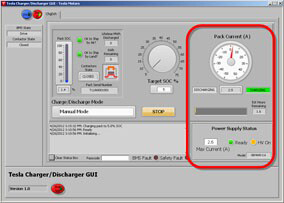
- When the target SOC is reached, the tool automatically stops charging and opens the contactors. The charging operation can be manually stopped by pressing the Stop button in the software application. Note: The emergency stop switch on the charger/interface box can be used to immediately open the contactors in an emergency. Do not press the emergency stop switch except in an emergency, as it opens the contactors under load and disconnects power to the BMS, causing the Charger/Discharger Tool to lose communication with the BMS.
- When the operation is complete, make sure the contactor state is "Open", then engage the emergency stop switch.
- Wait until the voltage displayed on the HV DC Link Voltmeter is
less than 5V, then shut down the PC.
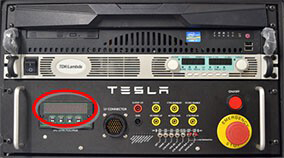
- Turn off all powered components.
- Disconnect the HV battery.
READ NEXT:
 Troubleshooting
Charging does not start. The green "Ready" light in the software
application is dimmed.
Check that the HV power supply is plugged in and turned
on.
Check the connections at th
HV Battery Coolant - Drain and Refill
Special tools required for this procedure:
Supplier
Part Number
Description
Tesla
1057671-
SEE MORE:
Reinstall Components
Installation of components is reverse of removal, except for the
following:
When reconnecting the HV cables to the charge port:
Remove any adhesive patch residue from the mating surfaces of
the high voltage cable lugs.
Remove any adhesive patch residue from the surfaces of the
Steering Column (Remove and Replace)
Removal
Ensure that the front road wheels are in a straight ahead
position.
Remove the driver's side lower dash trim (refer to procedure).
Remove the steering controller module (refer to procedure).
Disconnect the steering column motor harness connectors (x2).
© 2019-2026 Copyright www.tesms.org
