
Tesla Model S: Door - Charge Port - Non-Motorized (Remove and Replace)
Tesla Model S (2012-2026) Service Manual / High Voltage System / Door - Charge Port - Non-Motorized (Remove and Replace)
Removal
- Remove the LH tail light assembly (refer to procedure).
- Remove the screws (x3) that secure the charge port door to the
tail light assembly.
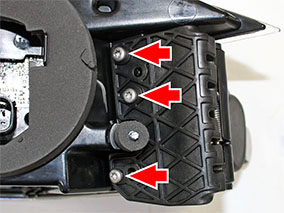
- Remove the charge port door.
Installation procedure is the reverse of removal, except for the following:
- Ensure that the studs on the tail light align with the slots on
the charge port door before installing the screws.
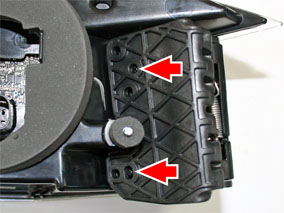
- Test the charge port door for proper fit and operation after the tail light is installed. Adjust the charge port door and tail light as necessary.
READ NEXT:
 Door - Charge Port - Single Phase - Motorized (Remove and Replace)
Note: The charge port door and motor are removed as an
assembly.
Removal
Remove the LH tail light assembly (refer to procedure).
Remove the screws (x3) that secure the charg
Slave Charger - LH - 1st Generation (Remove and Replace)
Note: This procedure describes how to remove and install
the 1st generation slave charger. If the vehicle is equipped with a
2nd generation slave charger, refer to procedure 44102102 (refer to
SEE MORE:
Pipe - High Pressure - Compressor to Condenser (Dual Motor) (Remove and
Replace)
Removal
Position the vehicle on a lift, but do not raise it at this
time.
Recover refrigerant from the vehicle (refer to procedure).
Remove the 12V battery (refer to procedure).
Remove the bolt that secures the high pressure pipe to the
compressor (torque 10 Nm).
Head Supports
The front seats include integrated head supports that
you cannot adjust.
The rear outboard seating positions include an
adjustable head support that can be raised/lowered or
removed. The head support should always be raised and
locked into position (so that the center is aligned with
the cente
© 2019-2026 Copyright www.tesms.org
