
Tesla Model S: Fascia Assembly - Rear (Remove and Replace)
Tesla Model S (2012-2026) Service Manual / Body / Fascia Assembly - Rear (Remove and Replace)
Removal
- Remove the rear fascia for access (refer to procedure).
- Remove the bolts (x4) and plastic rivets (x2) that secure the diffuser tray to the rear fascia (torque 3 Nm).
- Release the clips (x15) that secure the rear fascia to the
diffuser and applique.
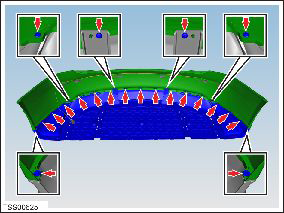
- Remove the rear diffuser and applique.
- Disconnect the parking distance sensor connectors (x4 or x6).
- Release the clips (x7) that secure the harness to the rear
fascia. Remove the harness.
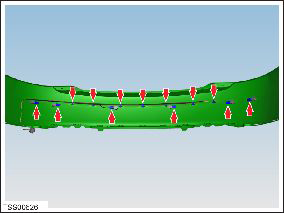
- Carefully release the parking distance sensors (x4 or x6) from
the rear fascia retaining rings.
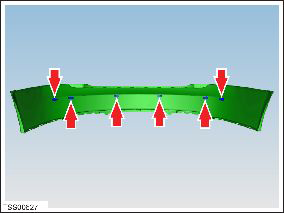
- Carefully release and remove the sensor retaining rings (x4 or x6) from the rear fascia. Caution: Care must be taken to avoid damage to paintwork and exterior trim.
Check the alignment of the rear fascia to the body. Adjust as necessary.
READ NEXT:
 Bumper Assembly - Rear (Remove and Replace)
Removal
Remove the rear fascia assembly for access (refer to procedure).
Remove the bolts (x8) that secure the bumper to the body (torque
52 Nm).
Diffuser Trim - Rear (Remove and Replace)
Removal
Remove rear diffuser (refer to procedure)
Remove plastic rivets (x2) and screw (x1) securing diffuser trim
to applique (torque 3 Nm).
Carrier - Bumper - Front (Remove and Replace)
Warning: If the vehicle has air suspension, activate "Jack"
mode on the touchscreen before raising and supporting the vehicle.
Removal
Recover refrigerant from the vehicle (refer
SEE MORE:
Charging Equipment
Charging equipment designed specifically to charge
your Model S is available from Tesla. A Tesla Wall
Connector, which installs in your parking space, is the
fastest way to charge Model S for daily use.
Model S can also be charged using a Mobile Connector
and the appropriate adapter(s) that all
Airbag Warning Indicator
The airbag indicator on the
instrument
cluster remains lit if the airbag system is
malfunctioning. The only time this indicator
should light up is briefly when Model S first
powers up, in which case it turns off within
a few seconds. If it remains lit, contact
Tesla immediately and do not dri
© 2019-2026 Copyright www.tesms.org
