
Tesla Model S: Lamp - Fog - Front - LH (Remove and Replace)
Tesla Model S (2012-2026) Service Manual / Electrical / Lamp - Fog - Front - LH (Remove and Replace)
Removal
- Remove the front fascia (refer to procedure).
- Release the clips (x4) that secure the fascia harness to the fog lamp assembly.
- Disconnect the fog lamp harness connector.
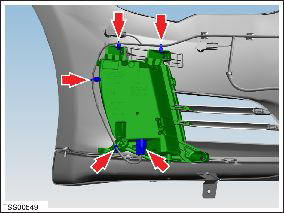
- Remove the screws (x3) and bolt that secure the fog lamp
assembly to the fascia.
.png)
- Remove the fog lamp assembly.
Installation procedure is the reverse of removal, except for the following:
- In the vehicle's configuration in Toolbox, set the "Front Fog" option to "Yes".
- Adjust the aim of the fog lamp as necessary (refer to procedure).
READ NEXT:
 Horn - 1st Generation (Remove and Replace)
Removal
Remove the front underhood apron (refer to procedure).
Remove the bolt that secures the horn to the bracket (torque 8
Nm).
Horn - 2nd Generation (Remove and Replace)
Removal
Remove the active center louver assembly (refer to procedure).
Place the active center louver assembly on a soft, clean surface
with the front of the duct assembly facing
Wiper Motor Assembly (Remove and Replace)
Removal
Ensure that the wipers are in the off position by rotating the
end of the left-hand steering column lever toward you.
Open the hood to the service position.
Remove the cow
SEE MORE:
LF Antenna - Center - Rear (Remove and Replace)
Warning: If the vehicle has air suspension, activate "Jack"
mode on the touchscreen before raising and supporting the vehicle.
Removal
Raise and support the vehicle (refer to procedure)
Warning: Do not work on an incorrectly supported vehicle.
Wa
Power Strut - Liftgate (Remove and Replace)
Removal
Open the liftgate.
Support the liftgate in the open position.
Remove the RH C-post upper trim (refer to procedure).
Release the RH rear corner of the headlining from the body.
Note: Do not remove the headlining.
Disconnect the power s
© 2019-2026 Copyright www.tesms.org
